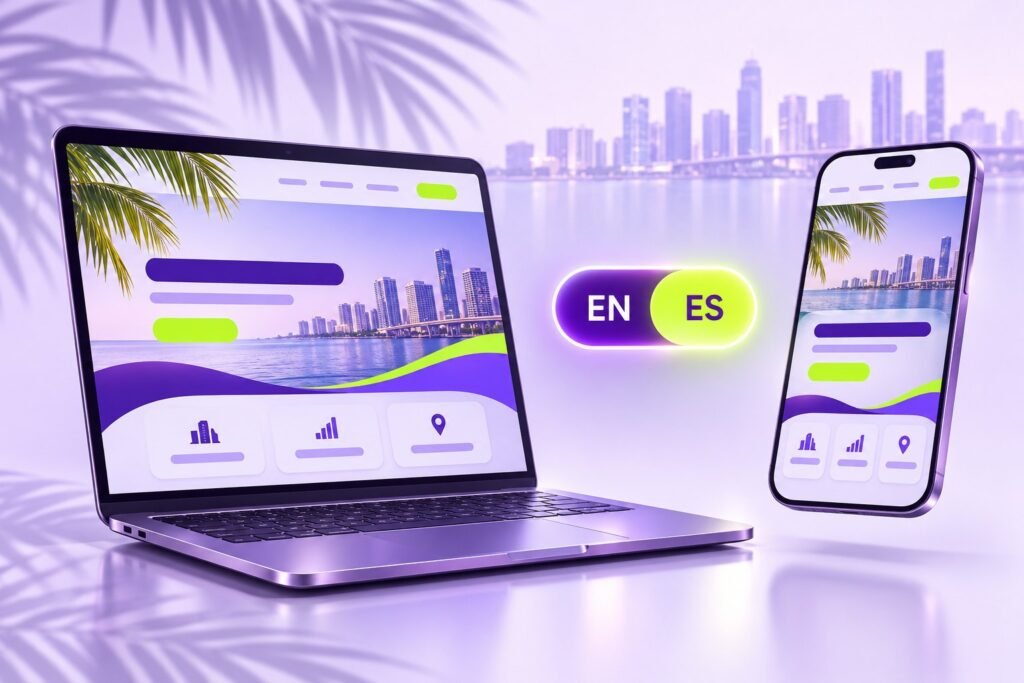
Do you need a bilingual website in Miami? If a real share of your customers prefer Spanish, yes. A bilingual website in English and Spanish helps more people understand what you offer, trust you, and contact you. In Miami-Dade, 75.3% of residents age 5 and older speak a language other than English at home, according to the U.S. Census Bureau, so for most local businesses a Spanish version is not a nice extra. It is part of reaching your market.
But “bilingual” means more than a translate button. This guide explains who really needs a bilingual website, what a good one includes, how it affects SEO, what it costs, and the mistakes we see most often on South Florida websites.
Key Takeaways
- In Miami-Dade, 75.3% of residents age 5+ speak a language other than English at home (U.S. Census, 2020-2024).
- A real bilingual website has full Spanish pages with their own URLs, not just a translation widget.
- Google recommends a separate URL for each language plus hreflang annotations, so the right version shows in search.
- Translate meaning, not words: Spanish forms, buttons and calls to action should sound natural to your customers.
- Planning both languages from day one is simpler and cheaper than adding Spanish later.
Contents
Who Needs a Bilingual Website in Miami?
Miami is one of the most bilingual markets in the country. The same Census profile shows that 54.5% of Miami-Dade residents were born outside the United States. Many of your customers switch between English and Spanish easily, but people often prefer their first language when the decision feels important: their health, their money, their home, their legal situation or their kids’ education.
You should strongly consider a bilingual website if:
- Customers already call, text or walk in speaking Spanish.
- You serve families, patients or homeowners making big decisions (healthcare, insurance, legal, real estate, home services, schools).
- Your team already answers in Spanish on the phone or in person.
- You post or advertise in Spanish on social media, and those people land on an English-only site.
- Competitors in your niche only offer English, which gives you an opening.
When can English-only work? If you sell mostly to national companies in English, or your audience is clearly English-first, one language may be enough for now. Even then, a Spanish landing page for your main service is a low-risk way to test demand.
If you already market in both languages on social media, our guide to bilingual social media marketing in Miami explains how to keep your message consistent from post to website.
What a Bilingual Website Really Means
A true bilingual website gives Spanish speakers the same experience English speakers get: the same services, the same clarity and the same easy way to contact you. In practice, that means:
- Full Spanish versions of your key pages (home, services, about, contact), not only the homepage.
- A clear language switch (EN | ES) in the header of every page.
- Spanish forms, buttons, error messages and thank-you pages.
- Spanish page titles and meta descriptions, so search results read naturally.
- A way to get answers in Spanish, by phone, WhatsApp or email.
That last point matters more than most owners expect. A beautiful Spanish page that leads to an English-only voicemail breaks trust fast. Before you launch, decide who will answer Spanish calls and form messages, and how quickly.
Translation Plugin vs. a Real Bilingual Site
Auto-translate widgets are tempting because they are fast and cheap. The trouble is quality and visibility. Here is how the two approaches compare:
| Translation widget | Real bilingual website | |
|---|---|---|
| Who writes the Spanish | Machine translation | A fluent writer, reviewed for your industry |
| Separate URL for each language | Often no; text swaps on the same page | Yes, for example /es/servicios/ |
| Chance to show in Spanish Google searches | Low | Good, when set up correctly |
| Tone and local terms | Literal, can sound awkward | Natural, written for Miami customers |
| Forms and confirmations | Often still in English | Fully in Spanish |
| Upkeep | Automatic, but errors go unnoticed | Needs a simple update routine |
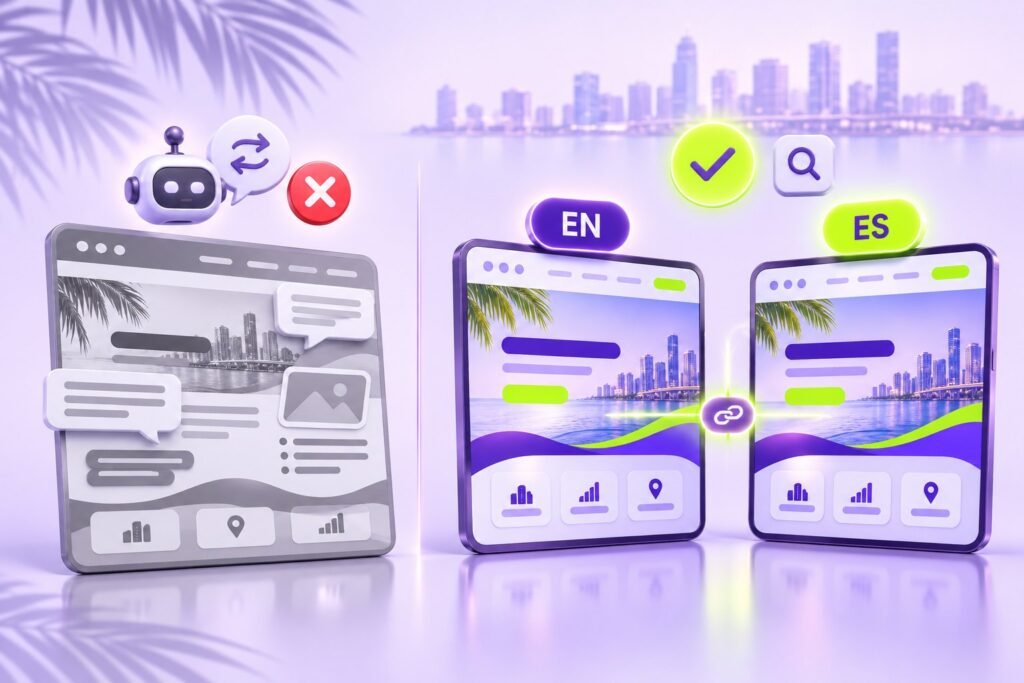
Machine translation can be a useful first draft. Just have a fluent person review every page before it goes live, especially prices, legal terms, health information and anything a customer might act on.
How a Bilingual Website Helps SEO (When It Is Set Up Right)
Spanish pages can help you show up for searches your English pages never will, like “dentista en Miami” or “techo nuevo precio.” But Google has to find them and understand them. Google’s own guide to managing multilingual websites recommends:
- Using different URLs for each language version instead of cookies or browser settings to change the language.
- Using hreflang annotations to tell Google which pages are versions of each other.
- Keeping one language per page for content and navigation, and avoiding side-by-side translations.
- Not redirecting visitors automatically based on a guess about their language. Let them switch.
Google also explains that it uses the visible content of a page to work out its language. A Spanish page with English menus and buttons sends mixed signals, so translate the whole page, not just the paragraphs.
Do Spanish keyword research, too. People rarely search with a word-for-word translation of your English keywords. Our SEO and AI search team looks at how your customers actually search in both languages, including in AI search tools like ChatGPT, Gemini and Google’s AI Mode. And don’t forget your Google Business Profile: it is often the first thing local customers see, so your services and posts there should speak to Spanish speakers as well.
What to Include on Your Spanish Pages
You don’t have to translate every old blog post on day one. Start with the pages that turn visitors into customers:
- Home page: what you do, where you work and how to reach you, in plain Spanish.
- One page per main service: written around the questions Spanish-speaking customers actually ask.
- About page: mention that your team speaks Spanish, if it does.
- Contact page: a Spanish form, phone number, WhatsApp if you use it, hours and address.
- Reviews: show them in the language they were written. Never rewrite a customer’s words and present them as theirs.
- Privacy policy and legal pages: have these translated professionally.
Tip: write for your real audience. Spanish speakers in Miami come from Cuba, Venezuela, Colombia, Nicaragua, Puerto Rico, Argentina and many other places, so clear, neutral Spanish usually works better than slang from one country.
Common Bilingual Website Mistakes
- Translating only the homepage and leaving every other page in English.
- Hiding the language switch in the footer.
- Using a single country’s flag for Spanish. “ES” or “Español” is clearer for a market as diverse as Miami.
- Mixing English and Spanish on the same page.
- Forgetting Spanish confirmation emails, thank-you pages and error messages.
- Updating prices or services in English and letting the Spanish pages fall out of date.
- Designing for English only, then finding that longer Spanish phrases break buttons and menus.
What Does a Bilingual Website Cost?
Adding a second language changes the price because there are more pages to write, design and test. For reference, here is how our website design options are priced at 1111 Media Group. Ask for English and Spanish when you request a quote, so the price reflects the real scope.
5-Day Website
$1,295
Up to 5 pages, live in 5 business days.
Custom Website
From $2,750
Most take 2 to 4 weeks.
Care Plans
From $350/mo
Ongoing help after launch.
If you need a smaller site quickly, the 5-Day Website is a good starting point. Larger bilingual sites with many service pages usually fit a custom build. For a full breakdown of what changes the price, read How Much Does a Website Cost in Miami?
A website also works best as part of a bigger plan. For example, for an air ambulance company, our work across website design, paid ads, social media and digital PR led to +185% call leads and +30% website traffic. You can see more results by industry in our case studies.
Frequently Asked Questions
Do I need a bilingual website if my customers also speak English?
Many Miami customers are fully bilingual, but people often prefer their first language for important decisions. A Spanish version makes it easier for them to choose you, and it gives you a chance to show up in Spanish-language searches.
Is Google Translate good enough for my website?
It can help with a first draft, but auto-translated text often sounds awkward, and widgets that swap text on the same URL are less likely to show up in Spanish searches. Google recommends a separate URL for each language. Have a fluent person review every page.
Will a Spanish version hurt my English SEO?
Not when it is set up properly. Give each language its own URLs and use hreflang annotations so Google knows which version to show each searcher. Keep one language per page.
How long does it take to build a bilingual website?
It depends on how many pages you need and how much content is ready. At 1111 Media Group, most custom websites take 2 to 4 weeks. Tell us up front that you need English and Spanish so the plan and timeline include both.
Can 1111 Media Group write the Spanish content?
Yes. We are a bilingual team in Miami, and we write and review website content in both English and Spanish so it sounds natural to your customers.
Ready to Reach Miami in English and Spanish?
Since 2011, 1111 Media Group has helped Miami businesses grow with websites, SEO, social media and ads, built by a bilingual team that knows this market. Tell us about your business and we will recommend the right bilingual website setup for your customers and your budget. Our ongoing services are month to month, with no contract.